


Social Studies
*Click on Curriculum Tab for activity details
Purpose
Our signature course features the likes of former mayor of Vancouver Sam Sullivan, BC Lieutenant Governor Hon. Janet Austin, Apathy is Boring founder Ilona Dougherty, celebrated political scientist Dr. Will Greaves, author of Article 35 of the Canadian Constitution Ian Waddell, Deputy Premier of BC Hon. Mike Farnworth, alongside former prime minister Rt. Hon. Kim Campbell, pollster Shachi Kurl, Global National anchor Dawna Friesen and Indigenous leader Dr. Leroy Little Bear. The voices of these experts and so many others provide students with a comprehensive understanding of the Canadian political system – from the legislative process and ideology to regionalism and the Crown’s duty to consult Indigenous nations – helping them learn the concepts mandated by provincial and territorial curricula (view complete curriculum connections) Additionally, students will cultivate a diverse range of tangible and intangible skills, including critical thinking, problem solving, decision-making, citizenship, policy analysis, economics, effective communication, the role and value of stakeholders, debate and presentation techniques, peer review, empathy and resiliency.
Goal
By the end of the course, students will understand the concepts set out in the curriculum and understand how to apply them in the real world, as citizens and through their careers. Nature Labs aims to help a new generation think more critically and act more creatively, today and every day.
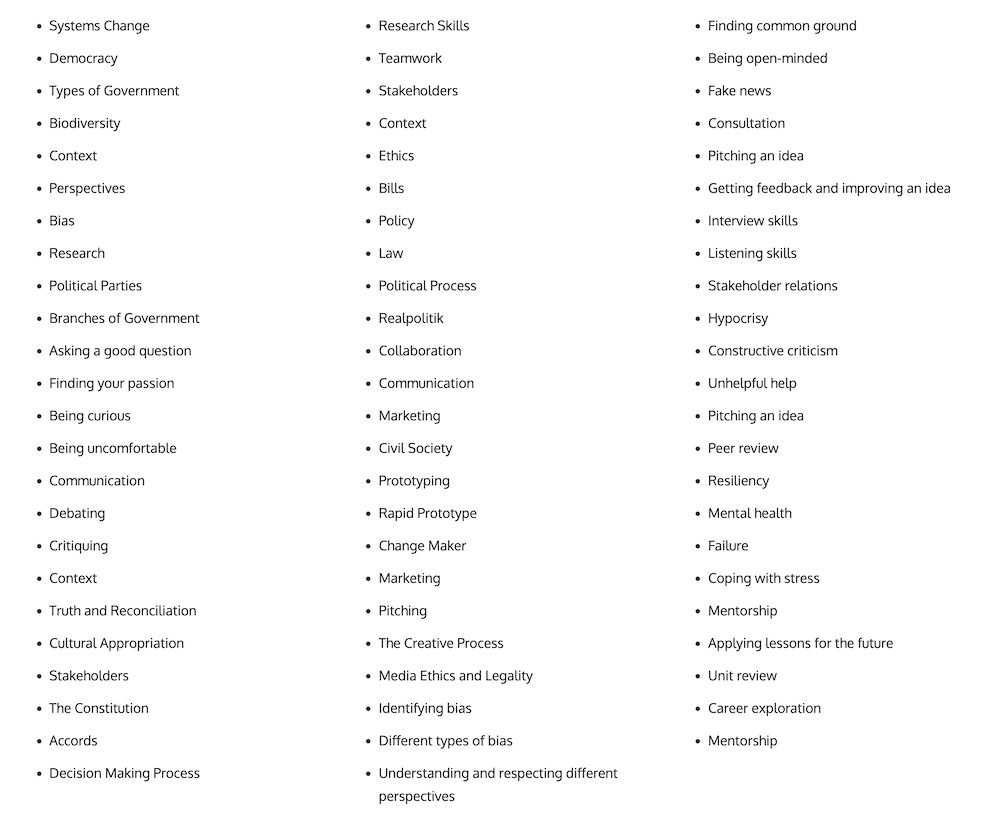
Key Terms and Concepts
Structure
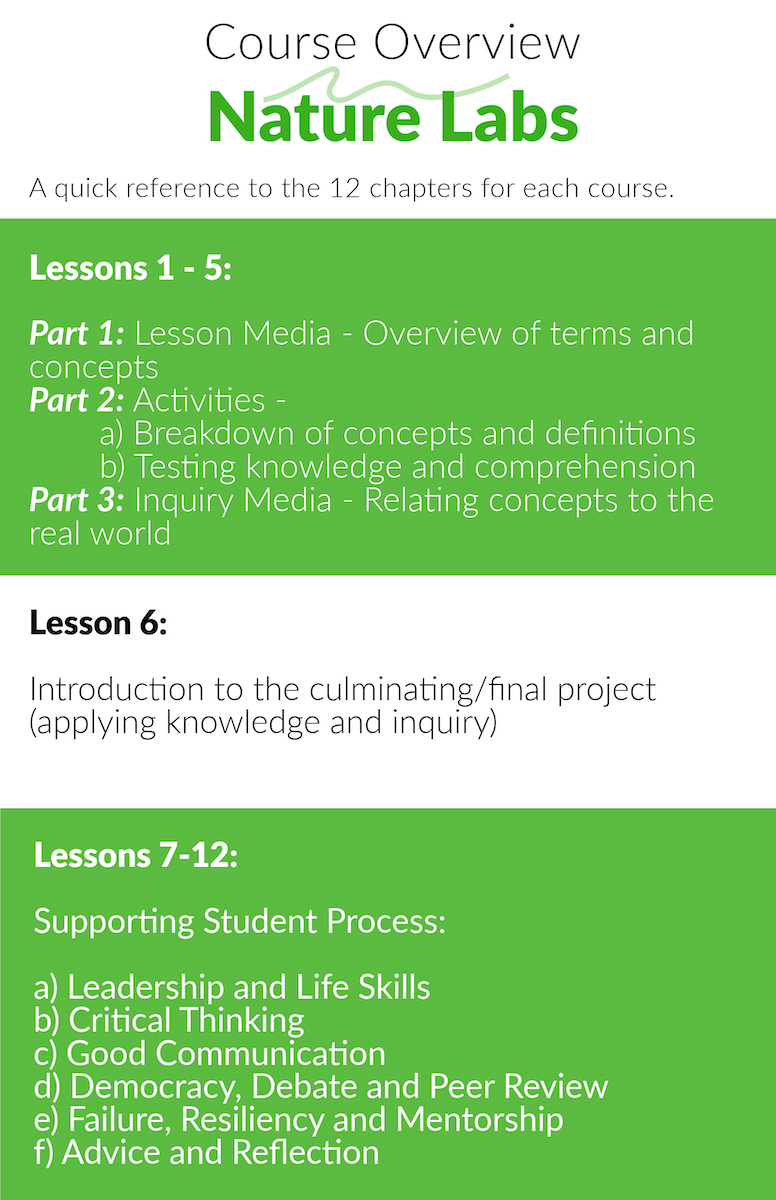
The course is broken down into twelve lessons, or chapters, with curriculum/curricula concepts explained through story and class activities.
Lessons One to Five: The first five chapters – which each include numerous breakout lessons for further skill-building opportunities – establish the knowledge base required to understand course concepts and terms.
Lesson Six: This lesson introduces students to their final project, which uses the principles of design thinking to test student comprehension of the course material.
Lessons Seven to Eleven: These lessons help students apply the knowledge they’ve gained through the first half of the course, with a focus on specific skill development (critical thinking tools, communication and presentation techniques, peer review and resiliency support, career-building ideas) that can help the class overcome obstacles as they pursue their final project.
Lesson Twelve: In addition to completing the final project, this lesson focuses on summarizing the course and leaving students inspired as they continue their academic, career and life journeys. Moreover, students are given the opportunity to submit their final project to Nature Labs and compete to have their project be the focus next year’s Inquiry Media.
Lessons
Lesson Media:
Each lesson begins with a story – and every story is available in video, audio or written formats to help with different learning styles and classroom preferences. Lesson Media stories in each chapter are designed as one large story, but can also be viewed as multiple individual stories, allowing you the flexibility to choose the content most appropriate for your class. Lesson Media is at the heart of how Nature Labs presents and explains course concepts and terms.
Lesson Activities:
Each lesson provides numerous activities for the class to explore the subject matter and test comprehension levels. Though most activities are optional, we recommend one activity per lesson that will help students develop their thinking as they move toward their final project.
Expert Conversations:
Every Nature Labs story features leading experts from across Canada and around the world. With each lesson, we spotlight the most relevant conversations and give students the opportunity to hear the full expert interviews in Podcast format. Additionally, every conversation featured in every story can be heard in full at any time, allowing students the opportunity to dig deeper on any given subject or perspective.
Curated Library:
The Curated Library is a research tool we provide students to help them better understand lesson material, aid homework assignments or the final project, and dig deeper on ideas that have surfaced during the course. With news articles, Podcasts, documentaries, research journals, infographics and so much more, we’ve analyzed over 3500 resources to give students a leg-up in finding the best information available in Canada.
Inquiry Media:
At the end of lessons 1-5, students will delve into a thought-provoking, inquiry-driven topic that uses a cross-curricular lens to connect course concepts to real-world issues and back to the communities where students live. These stories illustrate the importance of what they’re learning, the complexity of society and the incredible opportunity students have to create the world they want to live in.
Final Project:
The final project is an opportunity for students to apply what they’ve learned through the lens of the course, with the teacher able to decide whether it’s a written assignment or a verbal presentation. This project will help students understand the real-world career and citizenship applications of the course material. At the end of the course, students are given the opportunity to submit their final project to Nature Labs and compete to have their project be the focus next year’s Inquiry Media.
Class Organization:
Each lesson can involve individual tasks as well as group assignments, allowing teachers to choose where and when and how they want students to work. We have designed each lesson within each course to provide as much flexibility for both the teacher and the student. Indeed, Nature Labs works well with flipped classrooms, stations, independent and group work and through collaboration.
Note: While this course is grade 10-curricula connected across Canada, it can easily be adapted for other courses ranging from grade 7 to university level!
*Click on Curriculum Tab for activity details
Course Features
- Lectures 40
- Quiz 0
- Duration Lifetime access
- Skill level All levels
- Language English
- Students 1
- Assessments Yes
Curriculum
- 13 Sections
- 40 Lessons
- Lifetime
- Chapter One: The System of ThingsWhy does politics matter? Students will learn why this course matters, as well as the core concepts and terms that will be covered.4
- Chapter Two: The Context of it AllUnderstanding Canada's different regional contexts and why context matters in policy-making. Students will also explore political ideology and Canada's political parties.4
- Chapter Three: We Don’t Know What We Don’t KnowHow to dig deeper and learn what you don't know you don't know. Students will also investigate Canada's constitutional story, the role of treaties in policy-making, and the path to truth and reconciliation.4
- Chapter Four: Hard Stuff is HardHard decisions are hard, but good problem solving begins with asking the better question. Students will learn about diverse stakeholders and investigate complex political decisions.4
- Chapter Five: Here’s HowWhy process matters (and doesn't). Students will explore the legislative process and work to build real-world skills for policy-making and beyond.4
- Chapter Six: Your TurnIt's time to create! Students are introduced to their final project and are offered tools from diverse experts to help them excel.4
- Chapter Seven: Dig DeeperWhy critical thinking matters and how to be a better critical thinker. Students will build on and apply the knowledge they acquired in the first half of this course, in order to help them with their final project and in life.3
- Chapter Eight: Be BetterWords matter. Listening matters. Being heard matters. Students will explore the importance of good communication and consultation, while building on and applying the knowledge they acquired in the first half of this course as they pursue their final project.3
- Chapter Nine: Own Your HypocrisyDon't be a hypocrite: for the sake of our democracy, we need to be better critics. Students will work to improve their skills as both reviewers and reviewees, while putting their final project under the microscope for peer feedback.3
- Chapter Ten: Keep GoingKey Ideas: Keep going (sometimes). Students will explore different types of failure, why mentorship can help and the importance of resiliency.3
- Chapter Eleven: One Last ThingThat one thing everyone wishes they knew at 15. Students will explore life lessons from 150 diverse citizens and learn how this class can help them in the future, no matter what life they choose to live.2
- Chapter Twelve: The End (of the Beginning)This lesson will allow for students to effectively get their message across to an audience, through the Third Reading of the policy recommendation.1
- Additional Activities1